
If you’re building next year’s marketing plan for a fashion, beauty, or beverage brand targeting Gen Z in India, and music isn’t a line item in that plan, you’re not being cautious. You’re being absent.
India hosted 34,086 live events in 2025, and seven in ten people in that crowd were under 35. The market is compounding at 17.57% a year and is on track to be five times its current size by 2034. That’s not a trend worth a passing glance — it’s a new channel, and the brands treating it well aren’t buying a Q3 activation. They’re building it into the plan for the year, and the year after that.
"Your annual budget probably files music under 'experiential.' Wrong shelf. Music is where Gen Z builds identity, which makes it a brand-building channel, not an event line item."
India’s live music market, in one table
The scale is easy to underestimate if you haven’t looked at the numbers recently.
| Metric | Figure |
|---|---|
| India’s live music market (2025) | ₹11,600 Cr, up 44% year on year |
| Live events held in India (2025) | 34,086 — concerts, festivals, theatre |
| Projected annual growth through 2034 | 17.57%, reaching ₹49,600 Cr |
| Share of live audiences under 35 | 70% |
| Indians who crossed city lines for a concert (2025) | 5.6 lakh+ |
| Growth in Tier-2 city live shows (2024) | 682% |
Sources: Custom Market Insights · FICCI-EY M&E Report 2026 · Grand View Research
Where global music spending is headed
Goldman Sachs expects global music revenue to double to $200 billion by 2035, with 70% of new streaming subscribers coming from emerging markets. India currently sits at 8% music-streaming penetration against 38% in developed markets — the audience a brand can reach through streaming partnerships will likely triple within five years. That’s the floor, not the ceiling.
McKinsey’s research on Gen Z consumers across Asia puts India’s 375 million-strong cohort at the center of the next decade’s spending story. These are digital natives who spend six-plus hours a day on their phones, and for them, music isn’t background noise. It’s part of how they work out who they are.
What each tier of music investment actually buys
Music sponsorship isn’t one budget line. It’s three, and each buys something different.
| Tier | Investment | Examples | What it delivers |
|---|---|---|---|
| Tier 1 — Stream | ₹50L–₹1.5 Cr | Spotify/JioSaavn branded campaign, artist playlist takeover, contextual audio | 15–30L listener reach, contextual brand association, always-on presence |
| Tier 2 — Concert | ₹2–₹5 Cr | NH7 Weekender, Sunburn, city-level arena concerts, touring artist partnerships | 30K–80K live attendees, 50–55% brand recall, earned media, product sampling |
| Tier 3 — Festival | ₹6–₹10 Cr | Lollapalooza India (official partner), major stadium-scale touring acts | Category ownership, official merch rights, 50K+ live audience, year-round brand equity |
Sponsorship costs are based on industry benchmarks. H&M’s Lollapalooza India partnership (2025–26) is a working example of Tier 3.
The most common mistake brand managers make is treating this as one indivisible line. A festival partnership at ₹6–₹10 crore isn’t a media buy, it’s category ownership — the brand’s name ends up on merchandise that 50,000 Gen Z consumers choose to wear because they’re proud of the night. It carries across streaming platforms, into fan-generated content, across social media for weeks on either side of the event. You’re buying twelve months of association, not two days of visibility.
At the mid-tier, concert partnerships run ₹2–₹5 crore for 30,000–80,000 live attendees and 50–55% recall. If a flagship commitment isn’t realistic yet, streaming integrations at ₹50 lakh–₹1.5 crore build contextual presence for a fraction of the cost. The real question isn’t which tier you can afford. It’s which tier fits where your brand actually sits with Gen Z right now.
The recall gap between a concert and a banner ad
For every rupee a concertgoer spends on a ticket, EY-Parthenon and BookMyShow found they spend another ₹5.85 around it: ₹2.20 on hotels and hospitality, ₹1.60 on travel, ₹1.20 on food, ₹0.85 on merch. At a 50,000-capacity show with a ₹6,000 average ticket, that’s a ₹175 crore consumer ecosystem circling the event. A brand integrated there sits inside that spend, not watching it from outside.
The budget math a CMO will actually sit through
Take a ₹25 crore Gen Z marketing budget and split it two ways: one entirely digital, the current default for most brands, and one with 40% redirected into music. The comparison is the kind that changes a budget review.
| Line item | Allocation A — platform-first | Allocation B — music-integrated |
|---|---|---|
| Meta / Instagram | ₹15 Cr | ₹10 Cr |
| Influencer partnerships | ₹7 Cr | ₹5 Cr, music-anchored |
| OTT / YouTube pre-roll | ₹3 Cr | — |
| Lollapalooza India (official partner) | — | ₹8 Cr |
| Spotify / streaming campaign | — | ₹2 Cr |
| Total | ₹25 Cr | ₹25 Cr |
| Result | Allocation A | Allocation B |
|---|---|---|
| Reach | 7.5 Cr impressions (₹200 CPM) | 50K+ live attendees, 3–5× earned media |
| Average brand recall | 4% | 50–55% at the live touchpoint |
| Consumers who recall the brand | ~12 lakh | ~18 lakh |
| Cost per recalled consumer | ₹2,083 | ₹1,389 |
CPM benchmarks: Meta/IG Gen Z Tier 1 (₹200–250), AdAmigo.ai & ProductGrowth.in 2026. Lollapalooza sponsorship: industry estimate.
The music-integrated split produces roughly 18 lakh consumers who recall the brand at ₹1,389 each, against 12 lakh at ₹2,083 for the platform-first split — a 33% improvement in cost efficiency. But cost-per-recall undersells the real point.
What matters is what the 27,500 people who encountered the brand inside Lollapalooza actually carry home. They associate it with a peak emotional night. A digital impression can’t do that, and there’s no CPM metric for the quality of a memory, but there’s a real cost to never building one.
Three brands that already made the call
Three examples, three different plays.
H&M × Lollapalooza India
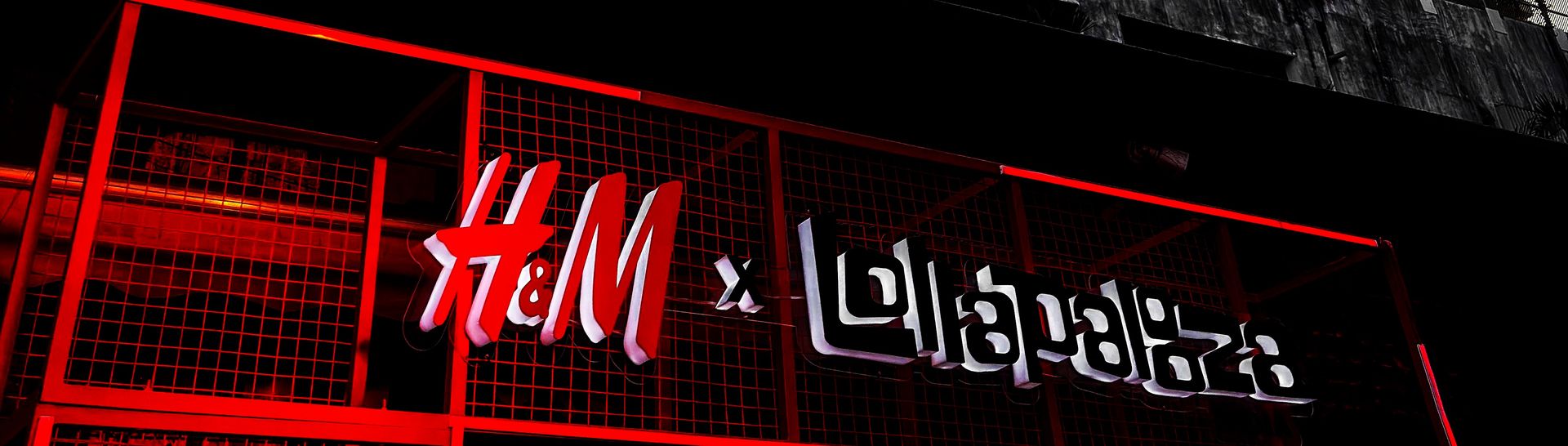
H&M treated the sponsorship as a runway, not a banner. At the 2025 edition it built The Sound of Style, a megaphone-shaped activation extended onto Spotify before and after the festival. By 2026 it had become Lollapalooza India’s official merchandise partner — its name now sits on clothing people buy because they want to remember the night.
Maybelline × Spotify India × Nikhita Gandhi
In June 2026, Maybelline launched Maybe It’s My Stage, a live concert experience built with Spotify India rather than a product launch with music playing in the background. The bet: getting ready for a show and stepping into a spotlight tap the same feeling for a young woman. It worked — a 20% jump in Gen Z engagement and 90% year-on-year growth in Gen Z audience on Pinterest.
HDFC Bank × Dil-Luminati
Diljit Dosanjh’s 2024 tour generated ₹943 crore in economic impact across 13 cities. HDFC made its Pixel card the exclusive ticketing gateway for a chunk of the shows and picked up 75,000 new customers and ₹80 crore in card transactions at the point of ticket purchase alone. The music didn’t build HDFC’s brand image so much as it built a pipeline: people opened an account because they wanted a Diljit ticket, and stayed because the product held up.
The window is open, but it won’t stay that way
India will likely host 60,000-plus live events a year by 2030, and Tier-2 cities are already growing shows at 682% year on year. Gen Z brand loyalty gets decided in the 18–25 age window, which McKinsey flags as the period when brand identity actually forms. That window is open now.
Music is where Gen Z works out who they are and which brands earn a place in that story. The concert has already started. The only real question left is whether your brand is building a memory there, or still just buying impressions somewhere else.
Sources and methodology
We can help incorporate music into your brand strategy
We have experience planning and activating large scale brand activations around the concert economy. Our detailed and ROI driven approach will surely be music to your ears.
Book a discovery call